ErecPower Official Website › Blog › Hawthorn berry
Why Is Hawthorn Berry In A Men’s Supplement?
A cardiac herb with a Cochrane review, sitting first on a men’s vitality panel. What its evidence actually covers, why the plant part matters, and the interaction that makes it the one to ask a pharmacist about.
- Hawthorn is a heart herb, not a sex herb. Its serious trial record is in chronic heart failure, and there is a Cochrane review of fourteen trials.
- The bridge is circulation. Erections are a vascular event and so is heart failure, but a drug that helps one does not automatically touch the other.
- It is the most regulated item on this panel. Hawthorn has a European herbal monograph. Nothing else here does.
- It also carries the clearest interaction. Digoxin, plus a blood pressure finding worth knowing.
- And, as ever, no amount is printed. The trials used 160 to 1,800 mg a day of a standardised extract.
General information, not medical advice. ErecPower is a dietary supplement for healthy adults aged 18 and over. It is not a drug, it is not FDA-approved, and it is not intended to diagnose, treat, cure or prevent any disease. Persistent difficulty with erections is frequently the first visible sign of a vascular, hormonal or medication problem a clinician can measure and often treat. If it is new or persistent, see a doctor rather than a sales page, including this one. Speak to a pharmacist before adding anything to a prescription.
Why it looks out of place
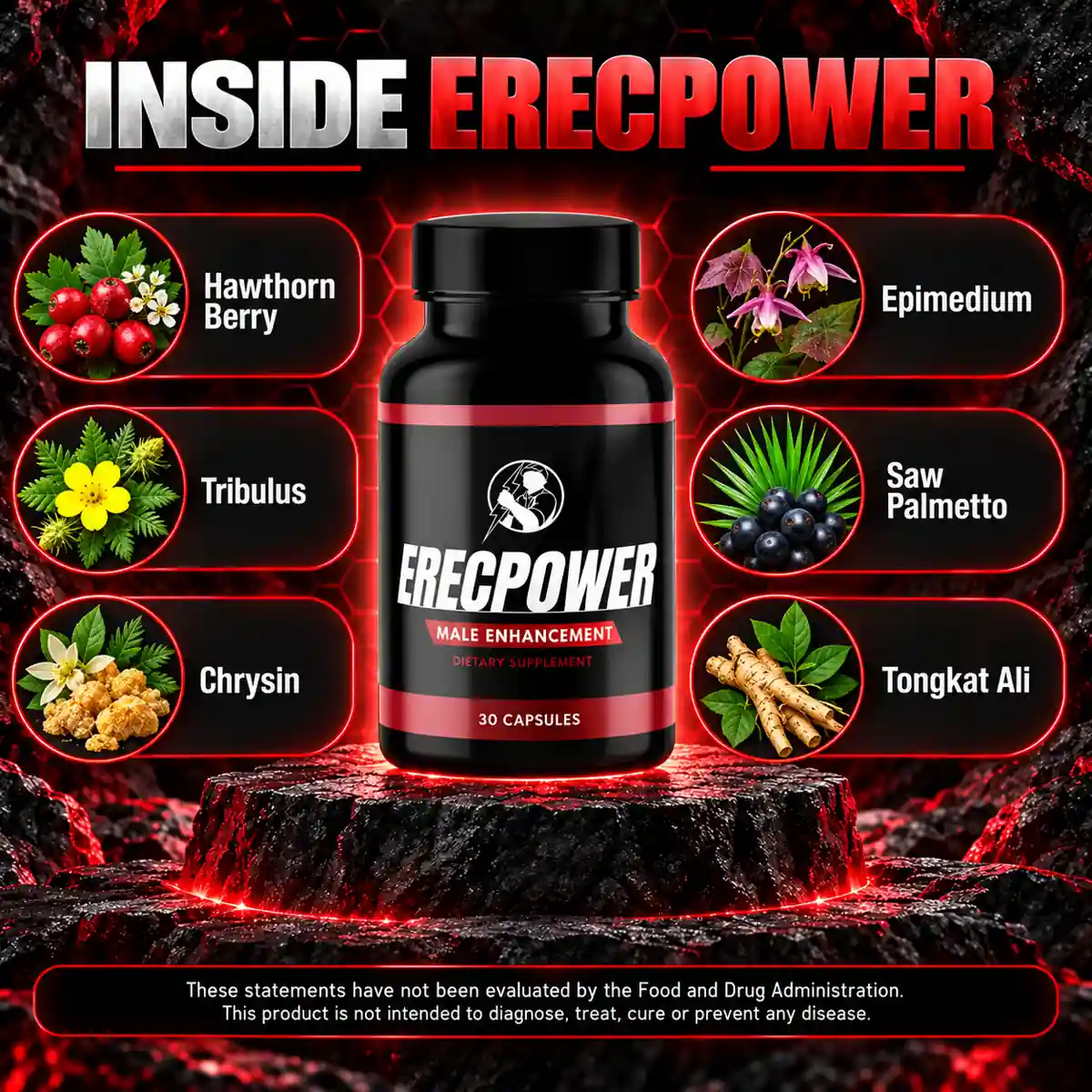
Read the six names on this label in order and one of them does not belong with the others. Tribulus, epimedium, saw palmetto and tongkat ali all arrive from the men’s health shelf. Chrysin arrives from the hormone shelf. Hawthorn arrives from cardiology, and it arrives with a considerably better trial record than any of them.
That is worth pausing on rather than skipping. In a category where formulas are usually assembled from whatever has the right reputation, an ingredient with a Cochrane review behind it is unusual. The question is whether the review is about anything a buyer of this product cares about, and the honest answer is: not directly, and the indirect route is longer than the marketing implies.
What hawthorn actually is
Crataegus is a genus of thorny hedgerow shrubs and small trees, common across Europe, North America and Asia. The parts used medicinally are the leaf, the flower and the fruit, which is the small red berry this label names.
Its measurable constituents are oligomeric procyanidins, which are the same class of polyphenol found in grape seed and pine bark, and a set of flavonoids including vitexin and hyperoside. Standardised extracts are usually described by their procyanidin or flavonoid percentage, and the standardisation is how one preparation is compared with another. It is also the first thing this label does not tell you.
NCCIH's page on hawthorn is the plainest public summary of where it stands, and it is more restrained than most of what is written about it.
The trial record, which is cardiology
The serious literature on hawthorn is about chronic heart failure. A Cochrane review pooled fourteen randomised trials of hawthorn extract as an adjunct to conventional treatment, and looked at symptom measures and exercise tolerance. That is a real body of evidence and it is why hawthorn is one of a very small number of botanicals with a European regulatory monograph.
It is also, for a buyer of a men’s vitality capsule, a body of evidence about somebody else. The participants had a diagnosed cardiac condition. The comparison was against standard heart failure treatment. The outcomes were symptom scores and exercise capacity, not anything sexual. None of that transfers by default to a healthy man taking a botanical capsule for a different reason.
| The hawthorn trial record | This product | |
|---|---|---|
| Population | Adults with chronic heart failure | Healthy men aged 18 and over |
| Comparison | Added to conventional cardiac treatment | Taken on its own |
| Outcome measured | Symptom scores, exercise tolerance | Sex life goals, stamina, circulation, testosterone support |
| Dose | 160 to 1,800 mg a day of a standardised extract | not published |
| Plant part | Leaf and flower in most trials | Berry, per the label |
| Duration | Weeks to months | Three to four weeks on this desk's record |
Five of the six rows differ. The sixth is blank on one side, which is the problem this website keeps returning to.
The circulation bridge, and how far it carries
There is a real argument connecting the two, and it deserves a fair hearing before it is taken apart.
An erection is a vascular event. Blood flow into the penile tissue depends on endothelial function, on nitric oxide signalling, and on the health of small blood vessels. Those are the same systems that go wrong in cardiovascular disease, which is why erectile difficulty is often described in urology as an early warning sign rather than a standalone problem. A meta-analysis of cross-sectional studies found it substantially more common in men with hypertension than in men without it.
So a botanical with genuine cardiovascular activity is not an absurd thing to put in a formula aimed at circulation. The bridge exists.
What the bridge does not carry is the trial result. Hawthorn improving symptom scores in people with heart failure, at a stated dose of a standardised leaf-and-flower extract, is not evidence that hawthorn berry at an unstated dose does anything for a healthy man’s erections. Those are two different populations, two different preparations, two different outcomes and, on one side, no dose at all. A 2021 review of the ingredients in this category makes the general version of this point across the whole aisle.
Berry, leaf or flower, and why the distinction matters
This is the kind of detail that gets lost and should not be. Most of the hawthorn trial literature, and the European monograph, concern leaf and flower preparations. This label says berry.
The berry is not a different plant, and it contains the same broad classes of compound. But the proportions differ, the standardisation differs, and a trial run on one preparation is not automatically a trial about the other. When a supplement label names a plant part that the research did not use, the citation gap widens by one more step.
- Leaf and flower: the preparation in most of the clinical record and in the European monograph.
- Berry: what this label names. Same genus, different material, thinner clinical record.
- Standardisation: procyanidin or flavonoid percentage. Not published here.
- Extract ratio: how much raw herb a milligram of extract represents. Not published here.
- Amount: not published here either.
Six botanicals, and one of them has a Cochrane review
ErecPower names hawthorn berry first. This article is what that name is actually worth, and what the label would have to print for it to be worth more.
$49 to $89 a bottle · 60-day money-back window
Order ErecPowerThe one regulated botanical on this panel
Hawthorn is the only ingredient on this label with a European Medicines Agency herbal monograph. Crataegi folium cum flore is the entry, and a monograph is a meaningful thing: it means a regulator has reviewed the traditional and clinical evidence for a herbal preparation and set out indications, dosing and safety.
Two things follow. The first is a point in hawthorn’s favour, and this article should say so plainly: among six botanicals, it is the one that has been through the most scrutiny. The second is less comfortable. A monograph exists because a substance is active enough to be worth regulating, and an active substance is one that can interact with other things you take.
The interactions: digoxin, and a blood pressure surprise
A crossover study in healthy volunteers examined digoxin taken alongside a hawthorn preparation. Digoxin has a narrow therapeutic window, which means the gap between a useful dose and a harmful one is small, and anything that moves its concentration matters more than it would for most drugs. If you take digoxin, this is a conversation to have with a pharmacist before the first capsule rather than after the third week.
The second finding is the one that surprises people. A 2019 meta-analysis and systematic review found that hawthorn extract combined with camphor significantly increases blood pressure. Camphor is not on this label, so the specific combination does not apply here. What it establishes is the general point: hawthorn is cardioactive, its direction of effect depends on what it is with, and treating it as an inert botanical is a mistake.
| If you take | Why it matters | What to do |
|---|---|---|
| Digoxin | Narrow therapeutic window, and a published interaction study | Ask a pharmacist before the first capsule |
| Blood pressure medication | Hawthorn is cardioactive and the direction depends on context | Ask, and mention the supplement at your next reading |
| A nitrate | Standard caution across this whole category | Ask, and read the safety page |
| Nothing on prescription | The interaction list is much shorter | Still tell your doctor you are taking it |
The full list for all six botanicals is on the safety and interactions page.
The doses the trials used, against a blank label
The hawthorn trials pooled in the Cochrane review used between 160 and 1,800 mg a day of standardised extract. That is an order of magnitude of range, which tells you the literature is not tidy, and it is still infinitely more information than this label provides.
Because this is the part that repeats on every article here: no amount is printed for hawthorn berry on this bottle, and no proprietary blend total is printed either. There is no ceiling to reason from and no floor to compare with. A capsule containing 5 mg of hawthorn and a capsule containing 400 mg would print the same label.
That matters in both directions, which is the fair way to put it. It means the trial results cannot be claimed, and it also means the interaction risk cannot be graded. An undisclosed amount may be too small to interact with anything at all. The ingredients page sets all six names against their trial doses in one table.
The verdict
Hawthorn berry is a defensible inclusion in a circulation formula and an oversold one in a sexual health formula. Its evidence is real, it is substantial by the standards of this aisle, and it belongs to cardiology rather than to anything the front of this bottle says. The bridge from one to the other is genuine but it does not carry the trial results across.
It is also the ingredient on this panel most likely to matter to somebody already taking something, which makes it the practical reason to have the pharmacy conversation before starting.
If you want the version of this argument applied to every name on the label rather than to one, the ingredients page has the full table, and the article on what will physically fit in a capsule is the one that puts a number on the problem.
Sources cited in this article
- Pittler MH, Guo R, Ernst E. Hawthorn extract for treating chronic heart failure. Cochrane Database Syst Rev. 2008;2008(1):CD005312. https://pubmed.ncbi.nlm.nih.gov/18254076/
- European Medicines Agency, Committee on Herbal Medicinal Products. Crataegi folium cum flore (hawthorn leaf and flower), herbal medicinal product. https://www.ema.europa.eu/en/medicines/herbal/crataegi-folium-cum-flore
- Tankanow R, Tamer HR, Streetman DS, et al. Interaction study between digoxin and a preparation of hawthorn (Crataegus oxyacantha). J Clin Pharmacol. 2003;43(6):637-42. https://pubmed.ncbi.nlm.nih.gov/12817526/
- Csupor D, Viczian R, Lantos T, et al. The combination of hawthorn extract and camphor significantly increases blood pressure: a meta-analysis and systematic review. Phytomedicine. 2019;63:152984. https://pubmed.ncbi.nlm.nih.gov/31255877/
- National Center for Complementary and Integrative Health. Hawthorn: usefulness and safety. https://www.nccih.nih.gov/health/hawthorn
- Wang XY, Huang W, Zhang Y. Relation between hypertension and erectile dysfunction: a meta-analysis of cross-section studies. Int J Impot Res. 2018;30(3):141-146. https://pubmed.ncbi.nlm.nih.gov/29785046/
- Kuchakulla M, Narasimman M, Soni Y, et al. A systematic review and evidence-based analysis of ingredients in popular male testosterone and erectile dysfunction supplements. Int J Impot Res. 2021;33(3):311-317. https://pubmed.ncbi.nlm.nih.gov/32358510/
Every page, every journal post, the bottle facts and the ingredients go through review by Dr. Goldwyn Foggie (Dr. Goldie), MD before they ship. We write from the printed ErecPower bottle, the manufacturer’s own listing artwork and this desk’s stock paperwork, cite public research beside the amount that research actually used, and print “not published” wherever a figure is not disclosed rather than estimating it. This label publishes no amount for any of its six botanicals, and that fact appears in every article that names one. Corrections are made on the page itself and the review date moves forward. Write to [email protected]. Last updated September 17, 2026.