ErecPower Official Website › Blog › Tribulus
What The Tribulus Trials Actually Measured
Two questions, two answers. The hormone studies found nothing, the questionnaire studies found something, and most of the argument about tribulus comes from treating those as one result.
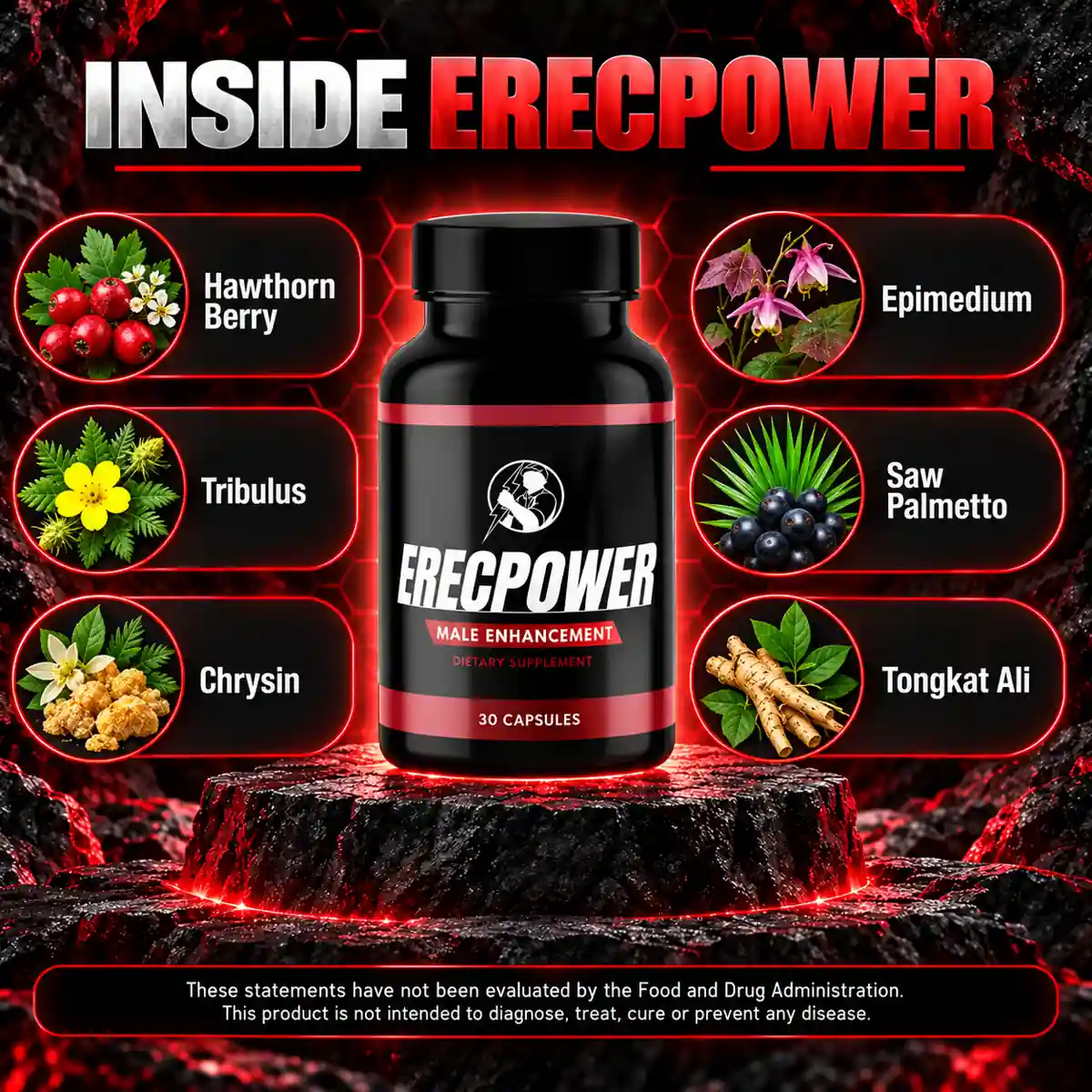
- There are two separate questions. Does tribulus raise androgens, and does it change sexual function scores? They have different answers.
- On androgens: no. The direct measurement study found no influence on androgen production in young men.
- On sexual function: mixed. The largest randomised trial reported improvement on questionnaire scores.
- A questionnaire is not a hormone assay. Most of the confusion in this literature comes from treating the two as one result.
- The label prints no amount. The trials ran 750 to 1,500 mg a day.
General information, not medical advice. ErecPower is a dietary supplement for healthy adults aged 18 and over. It is not a drug, it is not FDA-approved, and it is not intended to diagnose, treat, cure or prevent any disease. Persistent difficulty with erections is frequently the first visible sign of a vascular, hormonal or medication problem a clinician can measure and often treat. If it is new or persistent, see a doctor rather than a sales page, including this one. Speak to a pharmacist before adding anything to a prescription.
The reputation, and where it came from
Tribulus terrestris is a low creeping weed with spiny fruit, found across warm regions and regarded as a nuisance in most of them. Its supplement career began with Eastern European sports science in the 1970s and 1980s, and its reputation has run well ahead of its evidence ever since.
It is, by some distance, the most tested botanical in the men’s vitality aisle. That is the useful thing about it: where most ingredients in this category have a mechanism and a hope, tribulus has trials. The trials just do not say what the reputation says.
Two questions, not one
Almost every argument about tribulus is an argument between people answering different questions. Separating them makes the literature legible in about a minute.
Question one is hormonal. Does tribulus raise testosterone, or other androgens, as measured in blood or urine? This is a laboratory measurement with an objective answer.
Question two is functional. Do men taking tribulus report better scores on a validated sexual function questionnaire? This is a subjective measurement, which does not mean it is worthless, and it is the outcome that actually matters to a buyer.
A product can succeed on one and fail on the other. Tribulus, as far as the published record goes, does exactly that.
Question one: does it raise androgens?
The cleanest test of this was published in 2005. Neychev and Mitev, writing in the Journal of Ethnopharmacology, gave tribulus to young men and measured androgen production directly. The title is unusually candid for a paper about a supplement ingredient: the aphrodisiac herb Tribulus terrestris does not influence the androgen production in young men.
That is a small study in a young, healthy population, and it should not be treated as the final word. But it has not been overturned, and it is consistent with what the broader reviews have found since. The 2021 review of ingredients in popular male supplements put tribulus among the ingredients whose evidence does not support the claims made for it.
Question two: does it change sexual function scores?
This is where the literature gets more interesting and the answer gets less tidy.
Kamenov and colleagues, in 2017, ran the largest trial: a prospective, randomised, double-blind, placebo-controlled study of tribulus in male sexual dysfunction, published in Maturitas. It reported improvement on the questionnaire measures it used.
Santos and colleagues, in 2014, compared tribulus against placebo specifically in erectile dysfunction, in Actas Urologicas Espanolas. The results were more equivocal.
A 2026 systematic review and meta-analysis of randomised controlled trials of herbal supplements for erectile dysfunction is the most recent attempt to pool this kind of evidence across the category, and it is the right place to look for where the weight of it currently sits.
| Study | What it measured | Population | Result |
|---|---|---|---|
| Neychev 2005 | Androgen production, directly | Young men | No influence |
| Kamenov 2017 | Sexual function questionnaire scores | Men with sexual dysfunction | Improvement reported |
| Santos 2014 | Erectile function against placebo | Men with erectile dysfunction | Equivocal |
| Fernandez-Lazaro 2021 | Body composition, hormones, perceived exertion | Trained athletes, six weeks | No benefit found |
Read the second column before the fourth. Two of these measured hormones and found nothing; the two that found something were measuring how men reported feeling.
The athlete trial, which tested something else again
There is a third strand, and it is the one most likely to be quoted at you in a gym. Tribulus has a long-standing reputation as a training aid, on the same androgen premise.
A 2021 randomised, single-blind, placebo-controlled study put six weeks of tribulus supplementation against placebo in trained athletes and measured body composition, hormonal response, perceived exertion and performance. It found no benefit.
That result matters here because it tests the same premise as question one, in a different population, with different outcome measures, and reaches the same conclusion. When several independent approaches to the hormone question all return nothing, the hormone question is reasonably well answered.
Six botanicals, and the most tested one is the most misread
ErecPower names tribulus second. This article is what its trials actually measured, which is two different things with two different answers.
$49 to $89 a bottle · 60-day money-back window
Order ErecPowerWhy the two literatures disagree
There are three plausible explanations and they are not mutually exclusive.
The effect is not hormonal. Tribulus may do something to sexual function through a route that has nothing to do with androgens, in which case measuring testosterone was always the wrong test. Corona's review of androgens and male sexual function is a reminder that the two are less tightly coupled than the marketing assumes.
The questionnaire effect is expectation. Subjective outcome measures in this area are notoriously responsive to expectation, which is precisely why the better trials are placebo-controlled, and why the placebo arms in them often improve too.
The preparations differ. Which brings us to the next section, and to the reason two products labelled tribulus may not contain comparable material at all.
Protodioscin, standardisation and why products differ
The compound most often named as the active fraction is protodioscin, a steroidal saponin. Serious tribulus research uses extracts standardised to a stated protodioscin percentage, because raw material varies enormously with the plant part used, the region, the season and the extraction method.
Which means the word tribulus on a label carries almost no information on its own. An extract standardised to 40 per cent protodioscin and a ground whole-plant powder are entirely different products sharing a name, and only one of them resembles what the trials used.
- Plant part: aerial parts, fruit, or root. Not published on this label.
- Standardisation: protodioscin or total saponin percentage. Not published.
- Extract ratio: how much raw herb a milligram represents. Not published.
- Amount: not published.
- What that leaves: a name.
The doses, and the blank on this label
The published trials have generally run between 750 and 1,500 mg a day of a standardised extract, over weeks to months. That is a substantial daily amount of one ingredient, and it is worth holding in mind against a capsule that has to fit six.
This label prints no amount for tribulus, no standardisation, no plant part and no blend total. So the trials above cannot be claimed for this product, and they also cannot be ruled out. That symmetry is the honest position and it is unsatisfying on purpose.
The safety footnote nobody prints
Tribulus is generally well tolerated in the trials, and this section is not a warning about a dangerous ingredient. It is a note about what a trial population is and is not.
The randomised trials above enrolled adults, ran for weeks to months, used standardised extracts at stated doses, and excluded people with significant illness. That is the correct way to run a trial and it is also why a trial safety record is narrower than it sounds. The wider literature on tribulus contains scattered case reports of liver and kidney effects, generally at high intakes or in people with other things going on, and case reports are exactly the kind of evidence a controlled trial is not designed to produce.
Two practical consequences for somebody reading a label rather than a journal:
- A clean trial record is not a guarantee for you. If you have liver or kidney disease, or you take something metabolised hard by either, that is a pharmacist conversation rather than a website one.
- An unstated dose cannot inherit a trial’s safety profile any more than it can inherit the efficacy result. It cuts both ways: an undisclosed amount may be far below anything ever studied, in which case neither the benefit nor the risk applies.
- Tell your doctor you take it. Roughly half of supplement users do not, and it is how an ordinary finding gets investigated as something mysterious.
The full interaction list for all six botanicals on this panel, with the source beside each row, is on the safety and interactions page. Tribulus is not the row on that page that matters most; hawthorn and saw palmetto are.
The verdict
Tribulus does not appear to raise androgens. That question has been asked directly, in more than one population, with more than one method, and the answers keep coming back negative. Any product claiming a testosterone effect on the strength of tribulus is claiming something the literature does not support.
Whether it does something to sexual function is a genuinely open question, with a reasonable randomised trial on one side and a lot of expectation effect to control for on the other. A fair reading is: possible, unproven, and smaller than the reputation.
On this specific label it is a name with no number attached, which puts it in the same position as the other five. The one name on this panel with pooled evidence behind it is tongkat ali, and the ingredients page is where the six are compared side by side.
Sources cited in this article
- Neychev VK, Mitev VI. The aphrodisiac herb Tribulus terrestris does not influence the androgen production in young men. J Ethnopharmacol. 2005;101(1-3):319-23. https://pubmed.ncbi.nlm.nih.gov/15994038/
- Kamenov Z, Fileva S, Kalinov K, et al. Evaluation of the efficacy and safety of Tribulus terrestris in male sexual dysfunction: a prospective, randomized, double-blind, placebo-controlled clinical trial. Maturitas. 2017;99:20-26. https://pubmed.ncbi.nlm.nih.gov/28364864/
- Santos CA Jr, Reis LO, Destro-Saade R, et al. Tribulus terrestris versus placebo in the treatment of erectile dysfunction: a prospective, randomized, double blind study. Actas Urol Esp. 2014;38(4):244-8. https://pubmed.ncbi.nlm.nih.gov/24630840/
- Fernandez-Lazaro D, Mielgo-Ayuso J, Del Valle Soto M, et al. The effects of 6 weeks of Tribulus terrestris L. supplementation on body composition, hormonal response, perceived exertion, and CrossFit performance: a randomized, single-blind, placebo-controlled study. Nutrients. 2021;13(11):3969. https://pubmed.ncbi.nlm.nih.gov/34836225/
- Ho CY, Hsu CH, Chien TJ. Herbal dietary supplements for erectile dysfunction: a systematic review and meta-analysis of randomized-controlled trials. J Tradit Complement Med. 2026;16(1):109-120. https://pubmed.ncbi.nlm.nih.gov/41696741/
- Kuchakulla M, Narasimman M, Soni Y, et al. A systematic review and evidence-based analysis of ingredients in popular male testosterone and erectile dysfunction supplements. Int J Impot Res. 2021;33(3):311-317. https://pubmed.ncbi.nlm.nih.gov/32358510/
- Corona G, Rastrelli G, Vignozzi L, et al. Androgens and male sexual function. Best Pract Res Clin Endocrinol Metab. 2022;36(4):101615. https://pubmed.ncbi.nlm.nih.gov/35153145/
Every page, every journal post, the bottle facts and the ingredients go through review by Dr. Goldwyn Foggie (Dr. Goldie), MD before they ship. We write from the printed ErecPower bottle, the manufacturer’s own listing artwork and this desk’s stock paperwork, cite public research beside the amount that research actually used, and print “not published” wherever a figure is not disclosed rather than estimating it. This label publishes no amount for any of its six botanicals, and that fact appears in every article that names one. Corrections are made on the page itself and the review date moves forward. Write to [email protected]. Last updated September 17, 2026.